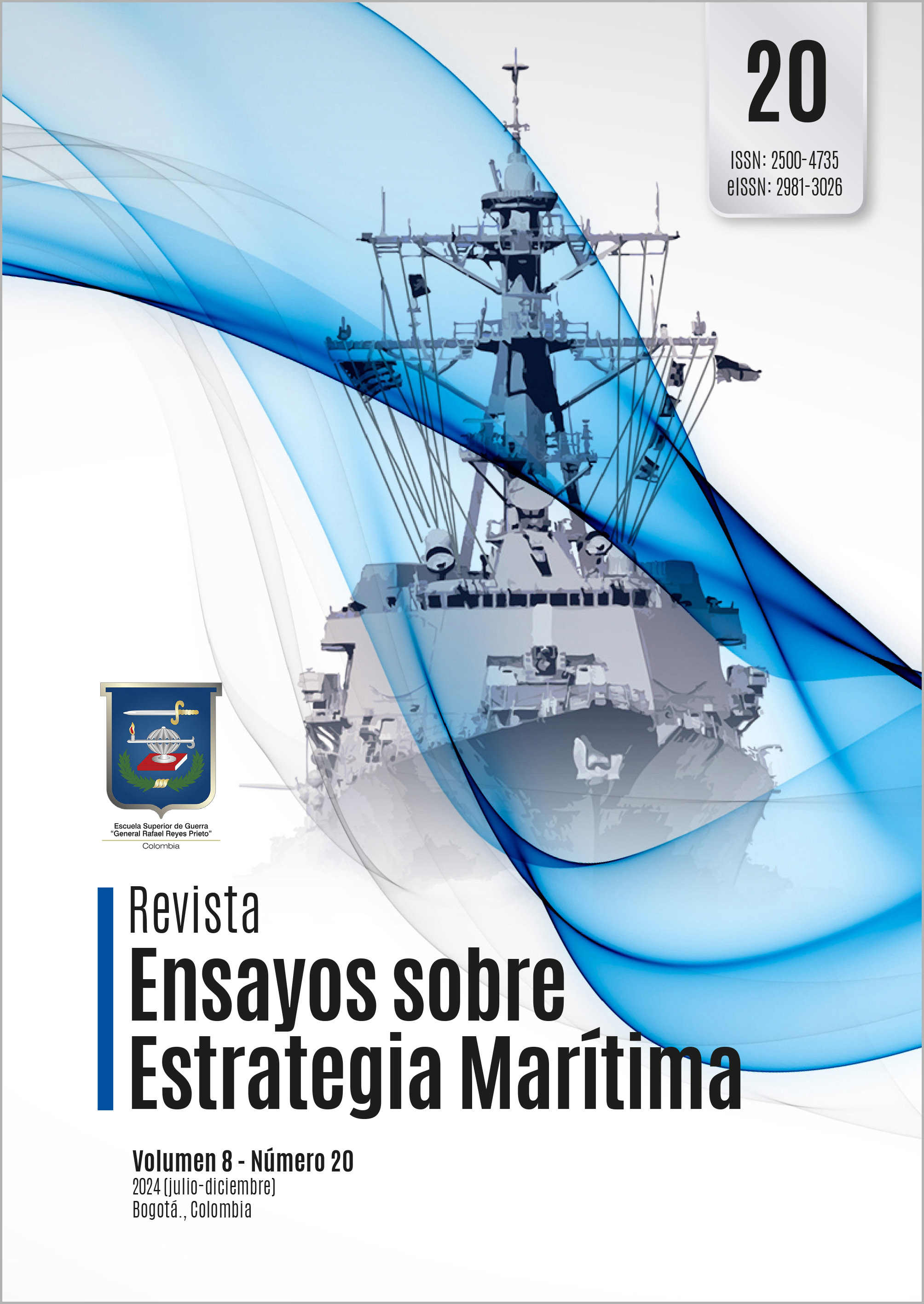
Propuesta de sostenibilidad para el Centro de Desarrollo Tecnológico Naval (CEDNAV) mediante el licenciamiento de innovaciones tecnológicas
DOI:
https://doi.org/10.25062/2500-4735.4926Palabras clave:
Armada Nacional, desarrollo tecnológico, innovación tecnológica, propiedad intelectualResumen
El Centro de Desarrollo Tecnológico Naval (CEDNAV) de la Armada Nacional de Colombia enfrenta el desafío de garantizar su sostenibilidad a largo plazo y fortalecer su capacidad para desarrollar y transferir tecnologías innovadoras al sector defensa. Este estudio analiza la importancia de implementar un modelo de licenciamiento de innovaciones tecnológicas como estrategia de sostenimiento para el CEDNAV, mediante una revisión sistemática de la literatura sobre modelos de licenciamiento de innovaciones tecnológicas aplicados en centros de desarrollo tecnológico a nivel internacional. Además, se examinan las principales barreras y oportunidades en la implementación de estos modelos en el sector defensa, considerando la experiencia de varios países. Como resultado, se reveló una amplia gama de modelos de licenciamiento, incluyendo enfoques como la innovación abierta, el licenciamiento estratégico, la colaboración y el intercambio de conocimientos, el licenciamiento basado en el desempeño y el licenciamiento socialmente responsable.
Biografía del autor/a
Breyner Jiménez Navia, Armada Nacional de Colombia
Capitán de Corbeta de la Armada Nacional de Colombia. Estudiante de la Especialización en Seguridad y Defensa Nacional, Escuela Superior de Guerra “General Rafael Reyes Prieto”, Bogotá. Magíster en gestión de innovación tecnológica, cooperación y desarrollo regional; especialista en estadística aplicada y desarrollo organizacional, e ingeniero industrial.
Referencias bibliográficas
Arora, A., Fosfuri, A., & Gambardella, A. (2004). Markets for technology: The economics of innovation and corporate strategy. The MIT Press.
Berman, E. P. (2012). Creating the market university: How academic science became an economic engine. Princeton University Press.
Bozeman, B. (2000). Technology transfer and public policy: A review of research and theory. Research Policy, 29(4-5), 627-655. https://doi.org/10.1016/S0048-7333(99)00055-4
Caviggioli, F., & Ughetto, E. (2019). A bibliometric analysis of the research dealing with the impact of additive manufacturing on industry, business and society. International Journal of Production Economics, 208, 254-268. https://doi.org/10.1016/j.ijpe.2018.11.022
Chesbrough, H. (2003). Open innovation: The new imperative for creating and profiting from technology. Harvard Business Press.
Chesbrough, H., & Bogers, M. (2014). Explicating open innovation: Clarifying an emerging paradigm for understanding innovation. En H. Chesbrough, W. Vanhaverbeke, & J. West (Eds.), New frontiers in open innovation (pp. 3-28). Oxford University Press.
Chesbrough, H., & Crowther, A. K. (2006). Beyond high tech: Early adopters of open innovation in other industries. R&D Management, 36(3), 229-236. https://doi.org/10.1111/j.1467-9310.2006.00428.x
Cohen, W. M., & Levinthal, D. A. (1990). Absorptive capacity: A new perspective on learning and innovation. Administrative Science Quarterly, 35(1), 128-152. https://doi.org/10.2307/2393553
Conti, R., Gambardella, A., & Novelli, E. (2019). Specializing in generality: Firm strategies when intermediate markets work. Organization Science, 30(1), 126-150. https://doi.org/10.1287/orsc.2018.1243
Etzkowitz, H., & Leydesdorff, L. (2000). The dynamics of innovation: From national systems and “Mode 2” to a triple helix of university–industry–government relations. Research Policy, 29(2), 109-123. https://doi.org/10.1016/S0048-7333(99)00055-4
Fosfuri, A. (2006). The licensing dilemma: Understanding the determinants of the rate of technology licensing. Strategic Management Journal, 27(12), 1141-1158. https://doi.org/10.1002/smj.562
Gambardella, A., Giuri, P., & Luzzi, A. (2007). The market for patents in Europe. Research Policy, 36(8), 1163-1183. https://doi.org/10.1016/j.respol.2007.07.006
Gans, J. S., & Stern, S. (2003). The product market and the market for “ideas”: Commercialization strategies for technology entrepreneurs. Research Policy, 32(2), 333-350.
Goldstein, A. (2002). The political economy of high-tech industries in developing countries: Aerospace in Brazil, Indonesia and South Africa. Cambridge Journal of Economics, 26(4), 521-538.
González-Pérez, M. A., & Mohieldin, M. (2020). South-South cooperation and technology transfer for sustainable development: Lessons from Latin America. Journal of International Development, 32(4), 565-586. https://doi.org/10.1002/jid.3474
Granstrand, O. (1999). The economics and management of intellectual property. Edward Elgar Publishing.
Granstrand, O. (2004). The economics and management of technology trade: Towards a pro-licensing era? International Journal of Technology Management, 27(2-3), 209-240. https://doi.org/10.1504/IJTM.2004.003953
Granstrand, O., & Holgersson, M. (2013). Managing the intellectual property disassembly problem. California Management Review, 55(4), 184-210. https://doi.org/10.1525/cmr.2013.55.4.184
Hall, B., Helmers, C., Rogers, M., & Sena, V. (2014). The choice between formal and informal intellectual property: A review. Journal of Economic Literature, 52(2), 375-423. https://doi.org/10.1257/jel.52.2.375
Hartley, K. (2011). The economics of defence policy: A new perspective. Routledge.
Hoegl, M., & Wagner, S. M. (2005). Buyer-supplier collaboration in product development projects. Journal of Management, 31(4), 530-548. https://doi.org/10.1177/0149206304272291
Kline, D. (2003). Sharing the corporate crown jewels. MIT Sloan Management Review, 44(3), 89-93.
Laursen, K., & Salter, A. (2006). Open for innovation: The role of openness in explaining innovation performance among UK manufacturing firms. Strategic Management Journal, 27(2), 131-150. https://doi.org/10.1002/smj.507
Lazaric, N., Mérindol, V., & Rochhia, S. (2011). Changes in the French defence innovation system: New roles and capabilities for the Government Agency for Defence. Industry and Innovation, 18(5), 509-530.
Lichtenthaler, U. (2011). Open innovation: Past research, current debates, and future directions. Academy of Management Perspectives, 25(1), 75-93. https://doi.org/10.5465/amp.25.1.75
Mani, S. (2011). Promoting knowledge-intensive entrepreneurship in India. En A. Szirmai, W. Naudé, & M. Goedhuys (Eds.), Entrepreneurship, innovation, and economic development (pp. 168-188). Oxford University Press.
Mazzola, E., Bruccoleri, M., & Perrone, G. (2012). The effect of inbound, outbound and coupled innovation on performance. International Journal of Innovation Management, 16(6), 1240008. https://doi.org/10.1142/S1363919612400087
Mimura, C. (2007). Technology licensing for the benefit of the developing world: UC Berkeley's socially responsible licensing program. Industry and Higher Education, 21(4), 295-301. https://doi.org/10.5367/000000007781698310
Mowery, D. C. (2010). Military R&D and innovation. En B. H. Hall & N. Rosenberg (Eds.), Handbook of the economics of innovation (vol. 2, pp. 1219-1256). North-Holland.
Ortega, H., & Rivera, J. P. (2019). Innovation and technology transfer in Latin America: The challenges of the regional integration. International Journal of Innovation Studies, 3(3), 73-81. https://doi.org/10.1016/j.ijis.2019.10.002
Pérez, C., & Truffer, I. (2010). Biotecnología para el desarrollo en América Latina: oportunidades y desafíos. En Innovación y desarrollo: Desafíos para Chile y América Latina. Universidad de Chile.
Perkmann, M., & Walsh, K. (2007). University–industry relationships and open innovation: Towards a research agenda. International Journal of Management Reviews, 9(4), 259-280. https://doi.org/10.1111/j.1468-2370.2007.00225.x
Rohrbeck, R., Hölzle, K., & Gemünden, H. G. (2009). Opening up for competitive advantage: How Deutsche Telekom creates an open innovation ecosystem. R&D Management, 39(4), 420-430. https://doi.org/10.1111/j.1467-9310.2009.00568.x
Roijakkers, N., & Hagedoorn, J. (2006). Inter-firm R&D partnering in pharmaceutical biotechnology since 1975: Trends, patterns, and networks. Research Policy, 35(3), 431-446. https://doi.org/10.1016/j.respol.2006.01.006
Rothaermel, F. T., & Alexandre, M. T. (2009). Ambidexterity in technology sourcing: The moderating role of absorptive capacity. Organization Science, 20(4), 759-780. https://doi.org/10.1287/orsc.1080.0404
Spithoven, A., Vanhaverbeke, W., & Roijakkers, N. (2013). Open innovation practices in SMEs and large enterprises. Small Business Economics, 41(3), 537-562. https://doi.org/10.1007/s11187-012-9453-9
Sempere, C. M. (2018). Collaborative innovation and intellectual property management: Challenges and opportunities. International Journal of Intellectual Property Management, 8(1-2), 1-15. https://doi.org/10.1504/IJIPM.2018.090403
Teece, D. J. (1986). Profiting from technological innovation: Implications for integration, collaboration, licensing and public policy. Research Policy, 15(6), 285-305. https://doi.org/10.1016/0048-7333(86)90027-2
Teece, D. J. (2018). Profiting from innovation in the digital economy: Enabling technologies, standards, and licensing models in the wireless world. Research Policy, 47(8), 1367-1387. https://doi.org/10.1016/j.respol.2017.01.015
Urraca-Ruiz, A., & Santos, G. A. (2013). The role of public research institutes in the Brazilian innovation system. En E. Albuquerque, W. Suzigan, G. Kruss, & K. Lee (Eds.), Innovative firms in emerging market countries (pp. 71-102). Oxford University Press.
Vanhaverbeke, W., Chesbrough, H., & West, J. (2014). Surfing the new wave of open innovation research. En H. Chesbrough, W. Vanhaverbeke, & J. West (Eds.), New frontiers in open innovation (pp. 281-294). Oxford University Press.
Van de Vrande, V., De Jong, J. P., Vanhaverbeke, W., & De Rochemont, M. (2009). Open innovation in SMEs: Trends, motives and management challenges. Technovation, 29(6-7), 423-437. https://doi.org/10.1016/j.technovation.2008.10.001
Cómo citar
Descargas
Descargas
Publicado
Número
Sección
Licencia
Derechos de autor 2024 Revista Ensayos sobre Estrategia Marítima

Esta obra está bajo una licencia internacional Creative Commons Atribución-NoComercial-SinDerivadas 4.0.